Every concert guitarist knows the feeling. You play a guitar in a shop or a workshop, it sounds adequate — controlled, perhaps a little dry. You bring it onto a stage, open the lid, play the first chord, and something unlocks. The sound fills the room in a way that felt impossible twenty minutes earlier. The guitar hasn’t changed. The room has.
Understanding why this happens is not just an academic exercise. For a luthier, it changes how you evaluate your own work, what you listen for when tap-tuning, and — crucially — what you optimise for when you know the guitar is destined for the concert hall rather than the living room. Projection is not a quality the guitar either has or doesn’t. It is a relationship between the instrument and the space it inhabits.
What projection actually means
The word is used loosely, sometimes to mean loudness, sometimes to mean presence, sometimes to mean something harder to define — the sense that a guitar is “speaking” to the back of the room. These are related but distinct properties, and conflating them causes a lot of confusion.
Loudness is straightforward: the total acoustic power radiated by the instrument, measured in decibels at a given distance. A guitar that is loud produces more energy per unit time. But loudness alone does not explain why some guitars carry in large rooms and others don’t. A guitar can be loud in the near field — close up — and still disappear at thirty metres.
Projection, properly understood, is about the efficiency with which high-frequency energy — roughly above 1 kHz — is radiated forward and outward. This matters because high-frequency sound is highly directional: it travels in narrower beams and loses energy quickly when it scatters off surfaces. A guitar that radiates strong upper harmonics forward will be heard clearly at a distance; one that concentrates its energy in the bass register or radiates it omnidirectionally will sound full to the player but thin to the audience.
The third property — presence, or “carrying power” — is partly about the attack transient: the sharp, percussive onset of each note that gives the ear a clear signal to lock onto even in a reverberant environment. Instruments with fast attack transients cut through reverb more effectively than instruments with slow ones. This is why a guitar with a slightly thinner sound can sometimes project better than a warmer, fuller-sounding one: the attack is cleaner, the harmonics start faster, and the room has less time to smear the onset before it reaches the listener.
The room as a second instrument
Sound does not simply travel from the guitar to the listener. It bounces, scatters, absorbs, and interferes with itself along the way. The result the listener hears is the sum of three contributions: the direct sound, early reflections arriving within the first 80 milliseconds, and the reverberant tail — the dense, decaying wash of reflected energy that persists long after the direct sound has passed.
The ratio of these three components changes completely depending on the room. In a small, treated space — a recording studio, a luthier’s workshop — the direct sound dominates. The listener is always within what acousticians call the “critical distance”, the point at which direct and reverberant energy are equal. Beyond that distance, the room takes over.
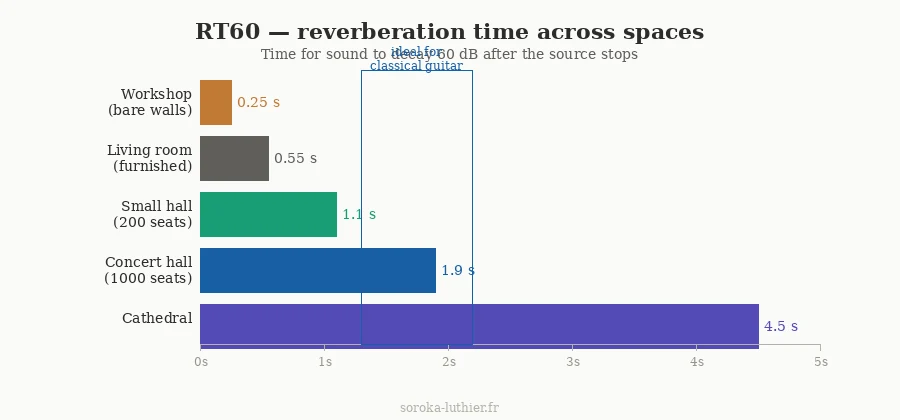
The key parameter is the RT60: the time, in seconds, for the sound level to decay by 60 dB after the source stops. A bare workshop might have an RT60 of 0.2 to 0.4 seconds. A well-designed concert hall sits between 1.5 and 2.2 seconds. A cathedral can reach 4 to 8 seconds or more.
In a room with a short RT60, notes separate cleanly, articulation is vivid, and every subtlety of fingering is exposed. The guitar sounds precise, perhaps a little naked. In a room with a longer RT60, notes blend into each other, the sustain of the instrument is augmented by the room’s own decay, and the overall effect is richer and more resonant — but clarity can suffer if the reverb time is too long. The great concert halls for classical guitar — the Wigmore Hall in London, the Herkulessaal in Munich, the Palacio de Festivales in Santander — sit in a range that provides both warmth and clarity, typically between 1.5 and 1.9 seconds.
Room modes and the luthier’s workshop
Every rectangular room has its own resonant frequencies, just as a guitar top does. These “room modes” are determined by the dimensions of the space: a room 5 metres long has a fundamental axial mode at approximately 34 Hz (the speed of sound, 340 m/s, divided by twice the room length). At this frequency and its multiples, sound builds up dramatically at certain positions and is almost absent at others.
This creates a serious problem for the luthier evaluating work in a small room. Standing waves in the bass register — below around 200 Hz — can make a guitar sound as though it has deep, resonant lows when it is simply coupling into a room mode. Move the guitar or the listener two metres, and the bass may largely disappear. The same guitar, evaluated in a different room or outdoors, can sound entirely different. This is not a defect; it is physics. But it means that the workshop is a systematically unreliable judge of low-frequency response.
The workshop is the worst possible place to evaluate the full sonic potential of a guitar. It is also, unavoidably, where every lutherie decision gets made.
Directivity: the geometry of sound
A guitar does not radiate sound equally in all directions. Low frequencies — below roughly 200 Hz — are emitted almost omnidirectionally, spreading in a sphere around the instrument. As frequency increases, radiation becomes progressively more directional, concentrating in a narrowing beam aimed roughly forward from the face of the guitar. Above 2 kHz, the soundhole and upper bout project a tight cone of energy that is strongly biased toward the audience in a performance setting.
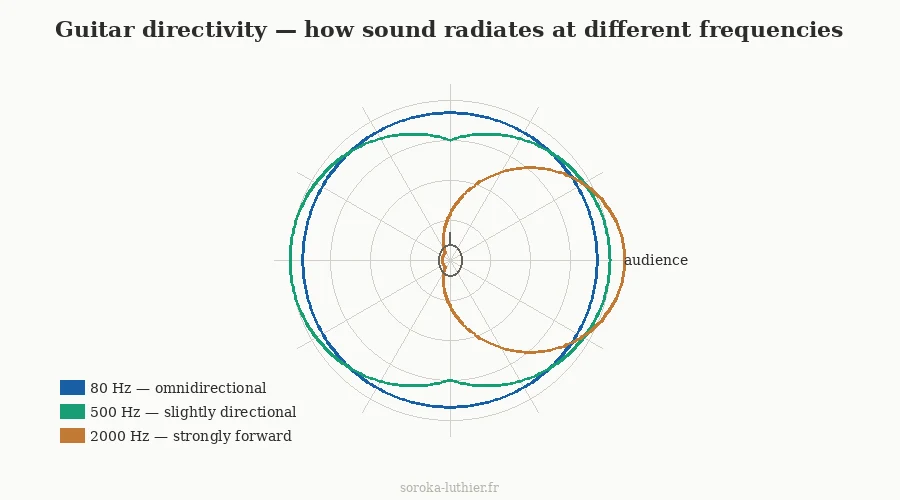
This directivity pattern has profound consequences. It means that the guitarist, seated behind the instrument, hears a radically different balance than the listener in the hall. The player is immersed in the bass and lower midrange — the omnidirectional components — while the high-frequency content, which gives presence and sparkle, is being projected forward, away from their ears. A guitar that sounds somewhat muted and bass-heavy to the player can simultaneously sound bright and projecting to an audience twenty metres away.
It also means that the position of the listener matters. Someone sitting to the side of the guitarist hears a different instrument than someone sitting directly in front. The off-axis response — the quality of the sound at angles away from the central beam — is one of the things that separates a truly great concert guitar from a merely good one. A guitar with a narrow, concentrated high-frequency beam projects well in the central seats but sounds thin to the sides. A guitar that maintains a broader, more even radiation pattern above 1 kHz fills the room more uniformly.
The singer’s formant — and what it teaches the luthier
Singers have a precise, physiological definition of projection that instrumentalists rarely discuss. A trained opera singer can be heard clearly over a full orchestra of eighty musicians — without amplification — not because they are louder, but because they have learned to concentrate acoustic energy in a specific frequency window that the orchestra leaves largely unoccupied.
This concentration is called the singer’s formant: a peak of spectral energy between approximately 2 500 and 3 500 Hz, produced by adjusting the resonant geometry of the larynx and pharynx. It takes years of training to develop, and its effect is measurable: a trained soprano or tenor will show a pronounced spectral peak in that range that is almost entirely absent in an untrained voice. The orchestra’s combined output falls off significantly in exactly this window. The voice slips through the gap.
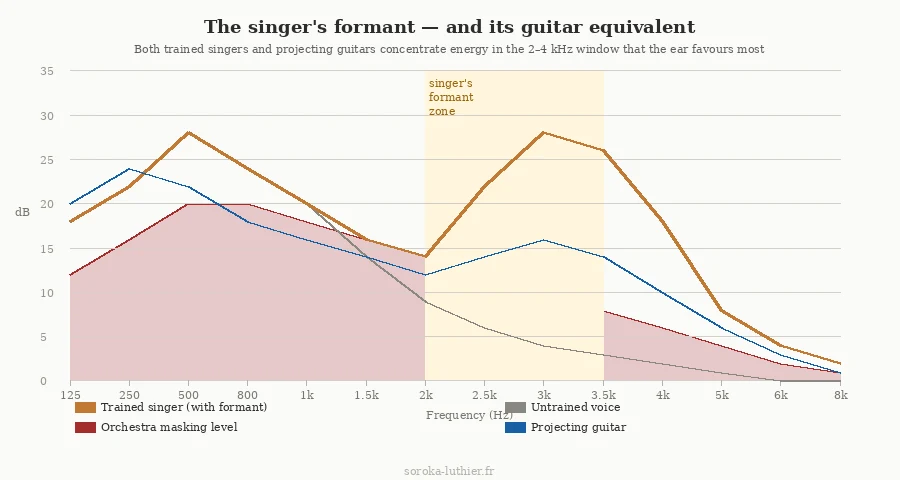
This is not a question of raw volume. It is spectral targeting — placing energy where the room and competing sound sources leave room for it, and where the human auditory system is most sensitive. The equal-loudness curves that define human hearing show a pronounced sensitivity peak between 2 and 5 kHz: sounds in this range are perceived as significantly louder than sounds of equal physical energy at lower or higher frequencies. The singer’s formant lands squarely in this window.
The parallel with guitar projection is exact. A guitar that projects well maintains strong energy in the upper partial range — roughly 2 to 4 kHz — where the ear is most sensitive and where the room’s reflections and ambient noise are weakest. A guitar that concentrates its energy in the bass and lower midrange sounds rich and resonant to the player, but its energy is in a range that the room smears and that the ear weights less heavily at distance. It disappears.
The implication for lutherie is this: optimising for projection means optimising for how well the instrument supports its upper harmonics, not simply how loud or full it sounds in the near field. The luthier who evaluates a guitar by how warm and resonant it sounds at close range may be systematically missing the quality that will determine how it sounds in the fifteenth row.
Torres never measured a formant. But the guitars he built have the same spectral property that allows a trained soprano to be heard over a full orchestra. He found it by listening — which may be the more remarkable achievement.
What the luthier controls
Projection is not an accident. It is the result of specific lutherie choices that influence how the soundboard radiates energy across the frequency spectrum, and how quickly it transfers vibrational energy to the air.
Top thickness and stiffness-to-mass ratio
A thinner, lighter top moves more easily and radiates more efficiently across the full frequency range. But a top that is too thin loses stiffness, its resonant modes drop into frequency ranges where they interfere with the fundamental response, and the guitar becomes difficult to control dynamically — it speaks too easily and saturates under strong playing. The classical balance is a top that is graduated carefully: thicker and stiffer in the central zone under the strings, graduating toward the edges, so that the driven area is controlled while the flanks can contribute to broader radiation.
Bracing and modal geometry
The fan bracing of the Spanish tradition does something specific: it creates a stiffness gradient that preferentially supports higher-frequency modes — T(2,1), T(2,2), and above — while leaving the low fundamental mode T(1,1) relatively free to vibrate at a low frequency. This distributes the guitar’s acoustic energy across a broader range of frequencies, which contributes to the perception of fullness and projection. A guitar that concentrates all its energy in the fundamental sounds boomy and undefined. One that supports a rich harmonic series sounds full and present throughout the room.
Attack and transient response
A stiff, well-braced top transfers energy to the air quickly. The attack transient — the first few milliseconds of each note — is sharp and clearly defined. This is what allows the guitar to project through reverb: the listener’s auditory system uses the onset of each note to extract pitch and articulation information, and a clean onset is harder for a reverberant room to obscure. This is one reason why cedar-topped guitars, which respond quickly due to their low stiffness-to-mass ratio, can project extremely well despite not necessarily being louder than spruce-topped instruments — the attack is fast and clean, and the room does the rest.
Finish and damping
The French polish finish — shellac applied by hand with a rubber — is not merely a tradition. It is, acoustically, the least damping finish available. A thick lacquer or polyester finish adds mass and internal damping to the top, softening the attack and reducing high-frequency radiation. French polish adds almost nothing. The difference is audible in the attack transient and in the brightness of the upper harmonics. A guitar finished in thin shellac projects differently — more immediately, with greater high-frequency presence — than the same guitar finished in a heavier coating.
Evaluating projection honestly
The practical difficulty for the luthier is that the workshop is the worst possible listening environment for assessing projection, and yet it is where all the decisions are made. There are a few strategies that help.
Playing at a distance. Even in a small room, moving to the far corner and listening from six or eight metres gives a much better sense of how the high-frequency components are projecting. The near-field bass bloat diminishes; the carrying power of the upper harmonics becomes more apparent.
Playing outdoors. Outside, there are no room reflections and no modes. What you hear is the direct sound of the instrument alone. Outdoors, a guitar with strong projection sounds surprisingly full; one that relies on room reinforcement sounds thin and distant. Torres, according to various accounts, habitually evaluated his instruments in the street outside his workshop for exactly this reason.
Recording and listening back. A microphone placed three to four metres in front of the guitar, slightly below the soundhole, captures something close to the audience’s perspective. Listening back through headphones removes the room entirely and reveals the instrument’s own character more clearly than playing in the room does.
Torres evaluated his guitars in the street outside his workshop. He was doing, intuitively, what acousticians now recommend: removing the room from the equation to hear the instrument alone.
What the guitarist hears vs. what the audience hears
This asymmetry — between what the player experiences and what the audience receives — is perhaps the most important and least discussed aspect of concert guitar acoustics. Because of the directivity pattern, the player is always listening to a bass-heavy, near-field version of the instrument. The high-frequency content that defines projection is, almost by definition, being sent away from the player’s ears.
This means that a guitarist who chooses instruments based primarily on how they feel and sound while playing may systematically undervalue the qualities that make a guitar carry in a large room. The guitar that feels most responsive, most resonant under the fingers, is not necessarily the one that projects most effectively into a hall. Some of the most celebrated concert guitars — instruments associated with exceptional projection and carrying power — are described by their owners as feeling surprisingly controlled and direct under the hands.
The best judges of a concert guitar’s projection are not the player and not the luthier. They are the people sitting in the fifteenth row.
Building for the room you cannot hear
For the luthier, this is the fundamental challenge. You build in a room that is acoustically nothing like the room the guitar will eventually inhabit. You evaluate through ears that are in the worst possible position relative to the instrument. You optimise for qualities — attack speed, high-frequency radiation, modal distribution — that are difficult to assess directly in a workshop setting.
The accumulated tradition of classical lutherie — the graduated top, the fan bracing, the thin finish, the precise geometry of the soundhole and upper bout — represents generations of empirical response to exactly this challenge. The luthiers who developed these conventions were building for the concert hall, even if most of them never had the opportunity to hear their instruments in one. They were optimising, through trial and error across centuries, for a relationship between instrument and room that they could feel in their hands but could only partially hear.
Understanding the acoustics does not replace that accumulated knowledge. But it can make the decisions feel less arbitrary. When you graduate the top a fraction thinner toward the treble side, when you leave the flanks of the lower bout slightly freer, when you apply the finish in the thinnest possible layer — you are not following a recipe. You are making choices about how sound will travel across a room to ears you will never see, in a space you will never enter.
Every lutherie decision is an acoustic decision. The room is always present, even when you cannot hear it.