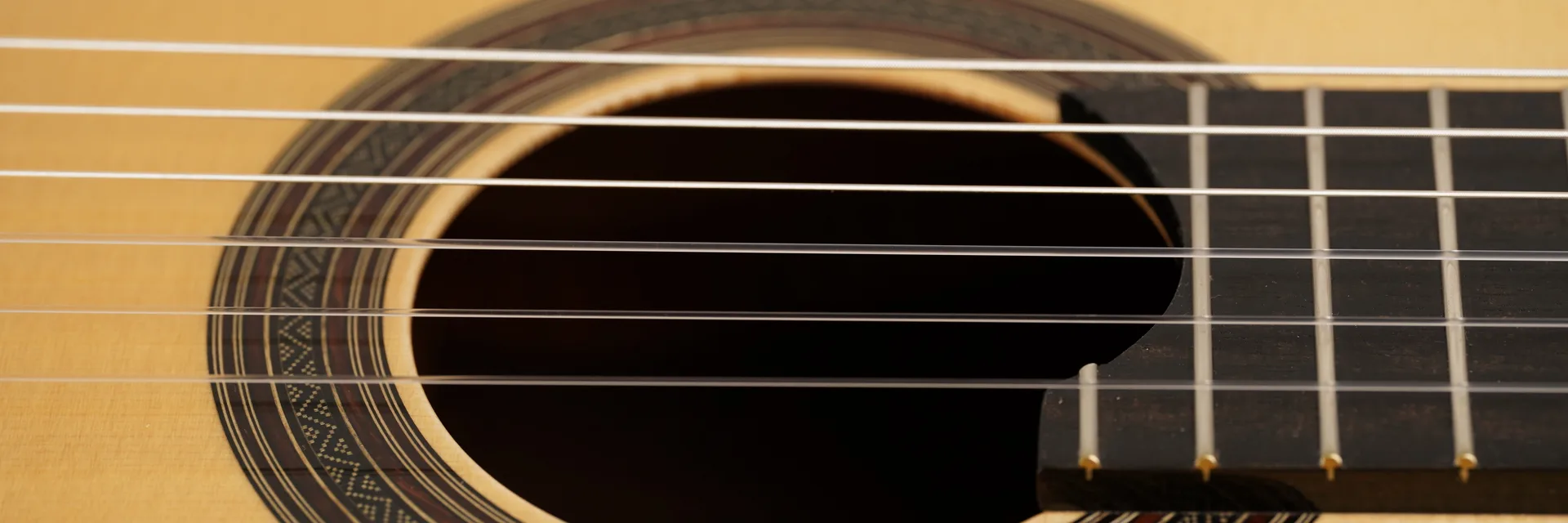
Every time you pluck a string, you set in motion one of the most elegant equations in physics. Long before Mersenne wrote it down in the 17th century, luthiers had figured it out by ear, by touch, and by the feel of a tap on a freshly graduated top. The relationship between a string, a soundboard, and the air around them is the reason a cedar-topped guitar sounds warm in your hands before it even reaches the audience — and understanding it changes how you listen to your instrument.
One string, many voices
When a string vibrates, it doesn’t just move at one frequency. It vibrates at its fundamental and simultaneously at every whole-number multiple of that frequency — the harmonic series. The second harmonic (the octave) divides the string in two equal halves, each moving in opposite directions. The third creates three segments. And so on, all happening at once, stacked invisibly on top of each other.
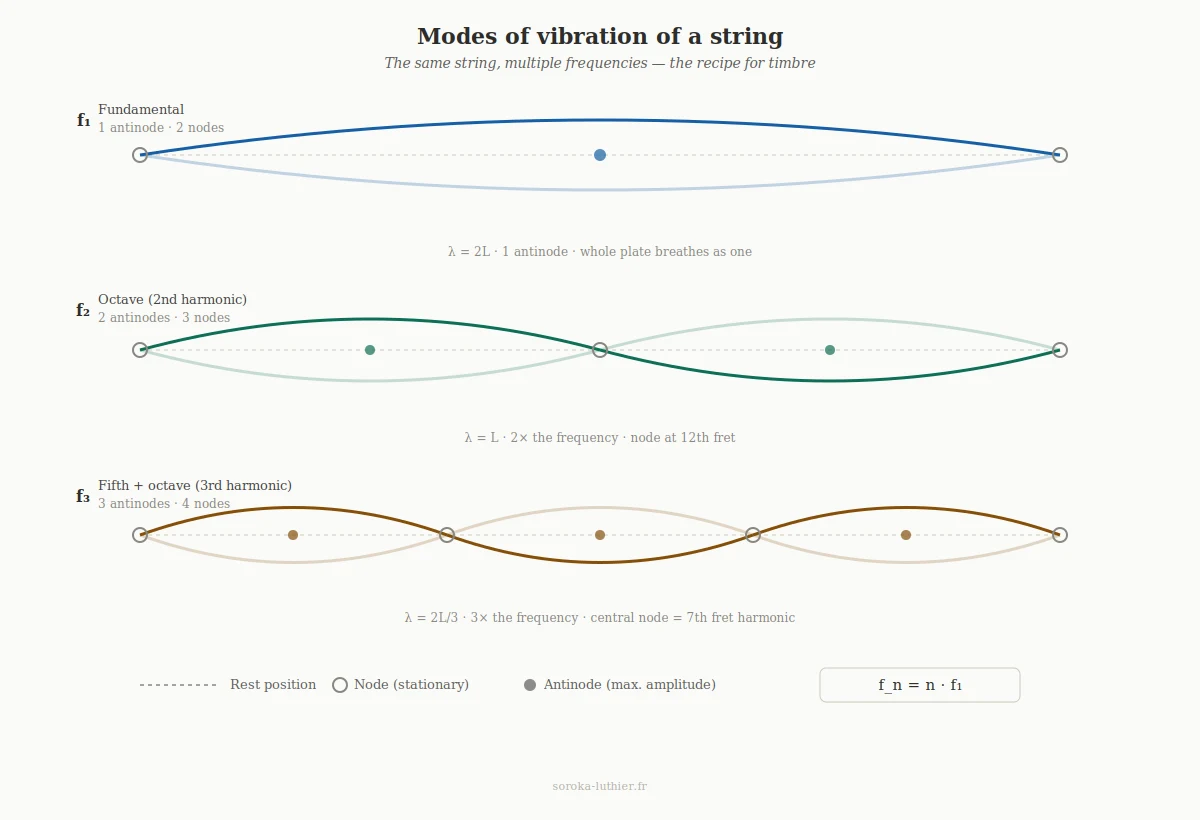
You already know these harmonics intuitively. When you lightly touch the string at the 12th fret and pluck, you’re forcing a node at the midpoint — silencing the fundamental and leaving only the even harmonics to ring. At the 7th fret you create a node at one-third of the string’s length, producing the third harmonic, a perfect fifth above the octave. The fretboard is, among other things, a map of the harmonic series.
The timbre of your guitar — the thing that makes it sound like itself and not any other guitar — is almost entirely determined by how these harmonics are weighted. Which ones are boosted, which ones are damped, how quickly they decay relative to each other. The string initiates this. The soundboard decides the outcome.
The soundboard as filter
A guitar top is not a passive amplifier. It’s an active filter — one with its own resonant frequencies, its own preferred ways of moving. These are called its normal modes, and a spruce or cedar top has dozens of them, each corresponding to a specific pattern of motion across its surface.
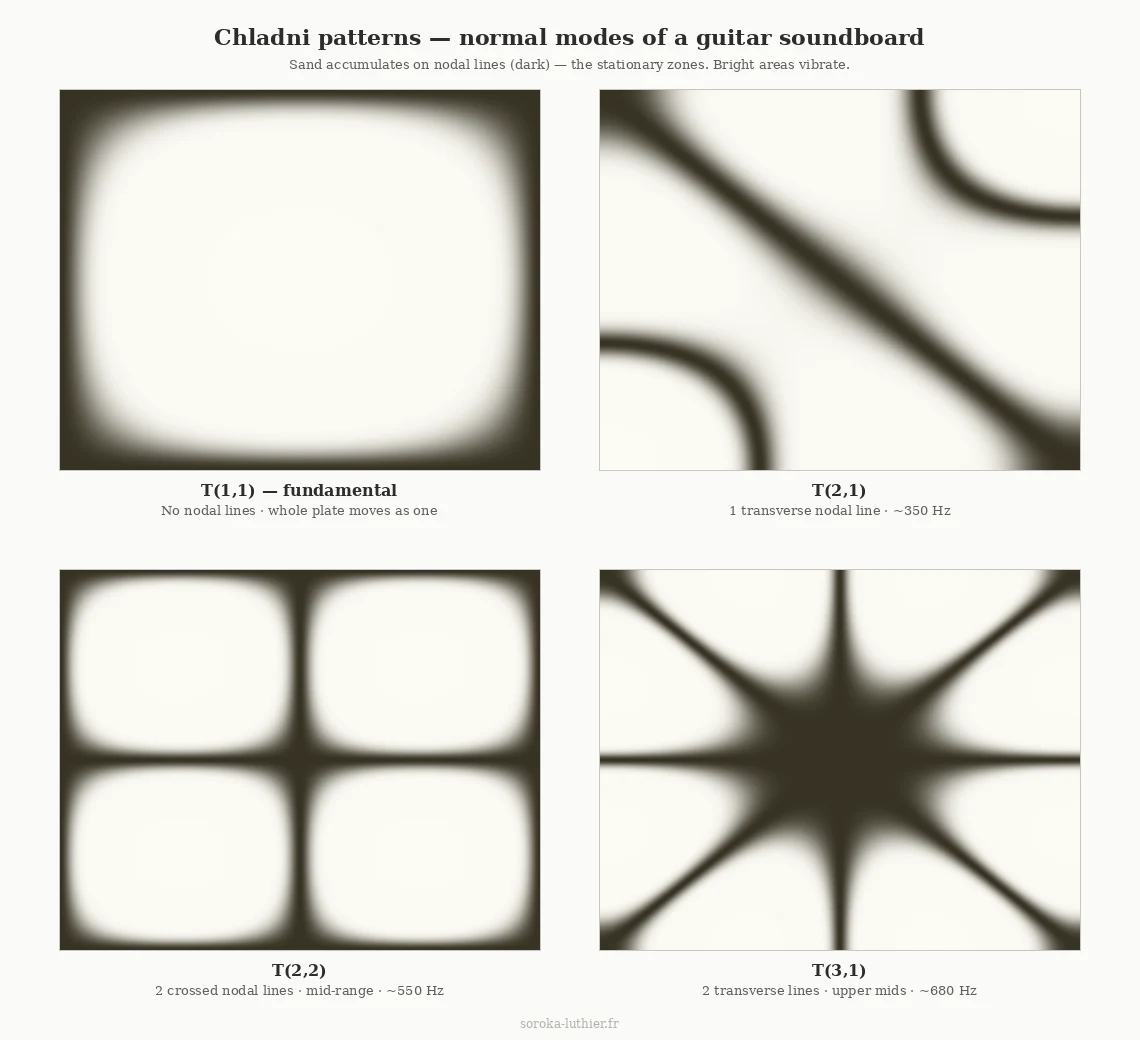
The most important of these is the lowest-frequency mode — often called T(1,1) — where the entire top moves as a single surface, expanding and contracting like a lung. This mode, typically somewhere between 150 and 250 Hz depending on the guitar, is responsible for projecting the fundamental of your lower strings and the body of the sound. When luthiers tap a top and listen for its resonant pitch, this is largely what they’re measuring.
Higher modes divide the top into zones that move in opposition: two areas moving up while two move down, separated by nodal lines where there is no motion at all. These modes amplify the mid and upper harmonics. The precise location of the nodal lines — and therefore which frequencies the top favors — is what bracing is designed to control.
Making the invisible visible: Chladni patterns
In 1787, Ernst Chladni took a metal plate, covered it with a thin layer of fine sand, and drew a violin bow across its edge. The sand fled from the areas that were vibrating and settled precisely along the lines that were not moving — the nodal lines. Within seconds, a perfect geometric form appeared on the plate. Chladni had done something remarkable: he had made a resonant mode visible.
Chladni toured Europe with his plates like a traveling attraction. Napoleon was so captivated by a private demonstration that he awarded him a prize to continue his research — one of the earliest examples of a government funding acoustics science. What struck audiences was not just the beauty of the patterns, but the implication: sound has shape.
What the patterns mean for a guitar top
At T(1,1), there are no nodal lines — the whole plate is one vibrating surface. At T(2,1), a single line appears across the width of the lower bout. At T(2,2), a cross: two lines, four zones. Each new mode adds complexity to the pattern and corresponds to a higher frequency band. The mode T(2,2), typically around 500 to 600 Hz, governs the projection of the mid-range frequencies that carry the body of melody on the upper strings.
Tap-tuning as Chladni by ear
When a luthier holds a graduated top between two fingers — always at a nodal point — and taps it with a knuckle, they are performing an informal version of Chladni’s experiment. The pitch they hear, and the way it sustains or dies, tells them which modes are dominant and whether the stiffness-to-mass ratio of the plate is in the right range.
A few contemporary makers now use signal generators and fine powder to visualize Chladni figures on their plates before closing the box. The sand tells you what the tap only suggests.
What the braces actually do
A soundboard is anisotropic — it is roughly ten times stiffer along the grain than across it. The braces don’t simply reinforce the top against string tension. They sculpt this stiffness asymmetry deliberately, pushing certain resonant modes higher in frequency, freeing others to vibrate more easily, and shaping the boundary between the stiff central zone under the strings and the more flexible flanks near the edges.
Here is the crucial insight: when you glue a brace onto a soundboard, you are placing it in a specific relationship to these nodal lines. A brace sitting exactly on a nodal line of a given mode leaves that mode largely undisturbed. A brace placed across a vibrational zone raises the frequency of that mode by stiffening the moving area. Moving a fan brace by even 5 millimeters can shift a resonant mode by 15 to 30 Hz — enough to make a specific string position feel alive or dead under the fingers.
Cedar and spruce: a question of ratio
The difference between a cedar top and a spruce top is not simply one of stiffness or density in isolation — it is a difference in the ratio of elasticity to density, the stiffness-to-weight ratio. Cedar is lighter and more elastic than most spruces. Its resonant modes sit lower in frequency and it responds more readily to a gentle touch. Players often describe this as warmth, or as a top that opens up immediately.
Spruce tends to have a higher stiffness-to-weight ratio. Its modes sit slightly higher, it demands more energy to excite fully, but when played with force it projects more upper harmonics and sustains the dynamic range over a wider span. Neither is superior. They are different instruments, shaped for different hands and different music.
The luthier’s knowledge
What strikes me most about this physics is how much of it was mastered by ear before it was ever written down. The Torres guitar — the template on which virtually all modern classical guitars are built — predates a coherent acoustic theory of the instrument by decades. Torres knew what he was doing not because he had read Helmholtz, but because he had listened, tapped, adjusted, and listened again.
Understanding the physics doesn’t replace that listening. But it can deepen it. When you hear a wolf note — a pitch that blooms and then dies too quickly — you now have a language for what might be happening: a resonant mode sitting too close to that note, robbing it of energy before it can sustain. When a guitar sounds different from one day to the next as the humidity changes, you can picture the top stiffening as moisture leaves the wood, shifting its modes upward almost imperceptibly.
Your guitar is a physics experiment that has been running since the day its top was graduated. Every note you play is data.